
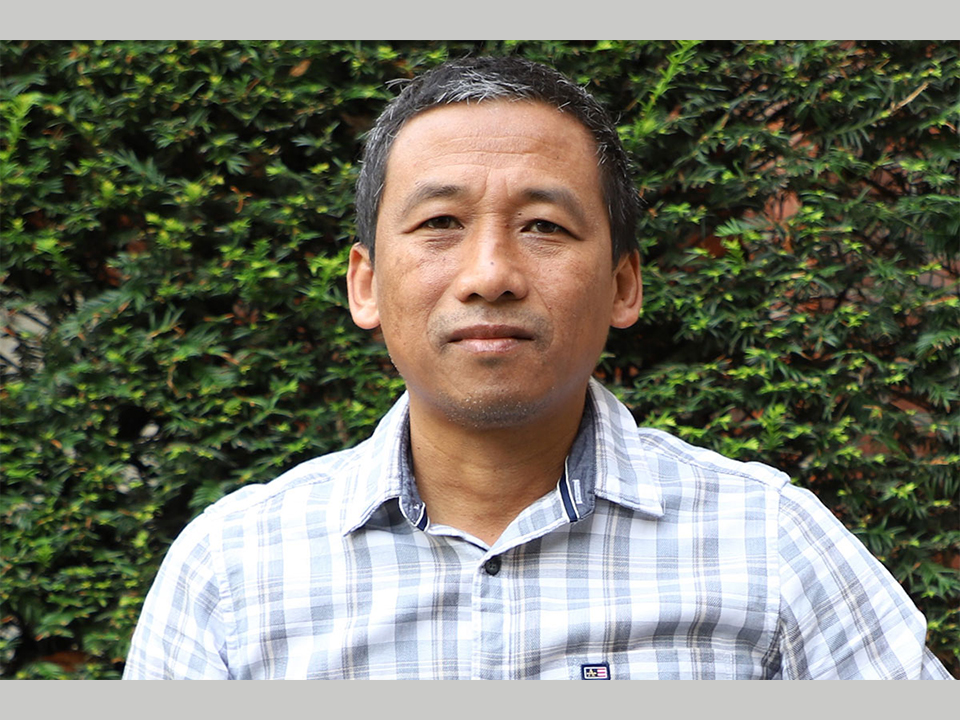
Dr Tiatoshi Jamir
Professor of Archaeology
Department of History & Archaeology, Nagaland University
Intellectual Biography
Tiatoshi Jamir is an Indigenous archaeologist from Nagaland whose deep interests situate around Northeast Indian prehistory, Naga monumentality, and explores ways of learning and knowing the human story of Northeast India's past, particularly Nagaland, from an Indigenous lens. Over a career spanning more than two decades so far, his work as an Indigenous archaeologist is best known from his long-standing community engagements with descent communities in archaeological research of Naga ancestral sites and offering a decolonizing perspective to the ways of doing archaeology in NE India.
His research on the cave archaeology of Nagaland also foregrounds the need to reconsider Northeast India as an important corridor of early human migration in prehistory. His continuing interdisciplinary research contributes to a better understanding of the archaeological dataset of the Mid-Holocene and the Late Holocene scenario of Northeast India, thus prompting global discussions on the nature of economic and technological regimes during the Holocene epoch across the Global South.
Since 1999, he has been engaged in teaching and research in the Department of History & Archaeology, Nagaland University, Kohima Campus, with an administrative component where he was the former Head of Department. Under the German Research Foundation, he was also a Mercator visiting Professor at the Institute of Pre- & Protohistoric Archaeology, Kiel University, Germany.
He received his PhD from the Department of Archaeology, Deccan College (Post-Graduate & Research Institute), Pune under the tutelage of Prof. K. Paddayya, a distinguished archaeologist whose work is globally recognised for his contribution to theory building in Indian archaeology and Stone Age studies. His doctoral research primarily deals with the ethnoarchaeology of Angami and Chakhesang Naga precolonial mortuary practices situating the idea of death, social complexities, and how they contribute to our understanding of death and society in prehistoric contexts.
Research Foci & Areas of Work
Jamir's research encompasses a wide range of archaeological and interdisciplinary themes:
- •Northeast Indian prehistory and Naga monumentality
- •Indigenous archaeology and decolonizing archaeological practice in NE India
- •Cave archaeology of Nagaland and early human migration corridors
- •Mid-Holocene and Late Holocene archaeology of Northeast India
- •Naga ancestral sites and community archaeology
- •Emergence of vegeculture/agriculture and village settlements
- •Material culture, social complexities, and monumentality in Naga stone monuments
- •Mortuary practices and archaeology & oral tradition
- •Community archaeology and decoloniality
- •Lithic technology and ethnotechnology of iron production
- •Bioarchaeology of jar/pit burials
- •Symbolic representations in the material world
- •Zooarchaeology and archaeobotany of Naga ancestral sites and prehistoric cave sites
- •Palaeoclimate and archaeology; soil micromorphology and cave archaeology
- •Stone Jars of North Cachar Hills, Assam (Dima Hasao) and Saipung area of Meghalaya
- •Archaeology and climate change in Northeast India
Highland Institute Projects
At the Highland Institute, Jamir is currently engaged in building institutional partnerships between Nagaland University and Highland Institute through collaborative research programs.
One such initiative is the ongoing Australian Research Council Project Climate Change Mitigation Strategies for Food Security in Northeast India where Jamir is one of the Principal Investigators. The Highland Institute is one of the collaborating institutions examining the food security concerns in Nagaland under this international research program.
Selected Publications & Knowledge Outputs
Journal Articles:
- 2026 — 'Settling for the Trowel rather than the Gun:' Indigenous Archaeology Perspectives from Northeast India. Asian Perspectives 65(1). Advance online publication on Project MUSE. https://muse.jhu.edu/article/991204
- 2025 — Indigenous archaeology further East: Experiences from the far Northeastern corner of India. Archaeological Dialogues 31(1): 24-31.
- 2024 — Decolonizing Archaeological Practice in Northeast India: Views from the Community Archaeology Initiatives in Nagaland. EAZ – Ethnographisch-Archaeologische Zeitschrift 57(1). https://doi.org/10.54799/JLZB5846
- 2023 — (with D. Tetso, Mepusangba, T. Changkiri) The Practice of Log Coffin Burial among Naga Communities of Highland Northeast India. Man and Environment XLVIII(2): 30-38.
- 2023 — (with A. Denaire, C. Jeunesse, M. Mitri) Une société mégalithique au pied de l'Himalaya (A Megalithic Society at the Foot of the Himalayas). L'Archéologue 166: 89-97.
- 2022 — (with M. Mitri, Mepusangba, H. Syiemlieh, L. Darnei, T. Thakuria, L. Kharpuri) Recent research on the stone jars of Northeast India: Evidence from East Jaintia Hills of Meghalaya. Archaeological Research in Asia 31, 100393. https://doi.org/10.1016/j.ara.2022.100393
- 2022 — (with Y. Ankit, P. K. Mishra, B. Mehta, A. Anoop, S. Misra) Hydroclimatic variability in Northeast India during the last two millennia: Sedimentological and geochemical record from Shilloi Lake, Nagaland. Palaeogeography, Palaeoclimatology, Palaeoecology 602, 111151. https://doi.org/10.1016/j.palaeo.2022.111151
- 2021 — (with M. Wunderlich, J. Müller, K. Rassmann, D. Vasa) Societies in Balance: Monumentality and feasting activities among southern Naga communities, Northeast India. PLoS ONE 16(3):1–36. https://doi.org/10.1371/journal.pone.0246966
- 2021 — Locating the Practice of Ethnography and Archaeology in Nagaland: Early Collections and Recent Trends. Puratattva 51: 166-188.
Book Chapters:
- 2026 — (with M. Mitri, T. Thakuria) Rethinking Northeast Indian Prehistory: Reappraisal to an Old Problem. In Exploring South Asian Past: Professor K. Paddayya Festschrift (V. Selvakumar et al. Eds.), pp.313-369. New Delhi: Aryan Books International.
- 2025 — Isüng Otsü –Our Story: Naga Repatriation as Decolonization Process. In Healing of the Lands: Reflections & Dialogues on the Naga Repatriation Journey (P. Kechu, Talilula Eds.), pp. 45-69. Kohima: Pen Thrill.
- 2024 — (with D. Tetso) Situating the 'Local' within the 'Locale': Local Communities and Community-Based Indigenous Archaeology in Nagaland, Northeast India. In The Oxford Handbook of Global Indigenous Archaeologies (C. Smith et al. Eds.). https://doi.org/10.1093/oxfordhb/9780197607695.013.61
- 2023 — Indigenous Archaeology. In The Routledge Companion to Northeast India (Jelle J. P. Wouters, T. B. Subba Eds.), pp. 256-261. Routledge.
- 2022 — (with J. Müller) Northeast Indian Megaliths: Monuments and Social Structures. In Megaliths of the World (L. Laporte et al. Eds.), pp. 447-474. UK: ArchaeoPress.
- 2022 — Archaeology of Northeast India. In Oxford Research Encyclopedias, Asian History (David Ludden Ed.) Pp. 1-32. Oxford University Press. https://doi.org/10.1093/acrefore/9780190277727.013.646
Books (in press):
- (T. Jamir/J. Müller Eds.) Indigenous Knowledge in Transformation: Northeast India. Leiden: Sidestone Press.
- (Müller et al.) Shangnyu Excavation Monograph, Mon District, Nagaland. Leiden: Sidestone Press.
- (Jamir, Tetso Eds.) Archaeology of the Mimi Caves, Kiphire District, Nagaland (Vol-1). Dimapur: Heritage Publishing.
Public Engagement, Teaching & Community Work
In conjunction with his research activities at Nagaland University, Jamir is engaged in teaching and mentoring both Master's and PhD students in the Department of History & Archaeology, NU, in areas such as theory and practice in archaeology, Northeast Indian prehistory, ideas of monumentality and agency, public archaeology, decoloniality, and publication ethics.
Whilst engaging with Indigenous communities from the region, as an Indigenous archaeologist himself, Jamir draws on the nature of positioning and self-reflexivity vis-à-vis one's affiliation to clan, village, cultural group, and land, which are critical to any anthropological and archaeological fieldwork undertakings in the region.
To further amplify Indigenous voices in archaeology and reaffirm Naga's heritage, he has been involved in local podcasts and radio programmes drawing public attention to the antiquity of Nagas' precolonial human habitation in the Naga Hills, while at the same time writing for local print and electronic media to educate students on career pathways in archaeology. He is also a strong advocate for the return of ancestral human remains in the ongoing Naga repatriation process with the Pitt Rivers Museum.
Recently, Jamir has been working with Indigenous communities in Nagaland to conduct joint research on Naga ancestral sites, including a partnership between Nagaland University, the University of Sydney, the Yimkhiung Tribal Council, and Kuthur and Langa communities to carry out archaeological work at Langa. This initiative led to the production of a community archaeology film entitled Stories from Langa (Nagaland University and University of Sydney 2025).
Other collaborative partnerships include New Phor village and Pochury Hoho with Nagaland University, the University of Sydney, and La Trobe University, Melbourne at the late Neolithic settlement of Burakha (New Phor); the collaboration between Nagaland University, Kiel University, and Konyak Naga communities of Shangnyu and Yannu village, Mon District, Nagaland.
Contact & Scholarly Infrastructure
Institutional Affiliation
Department of History & Archaeology
Nagaland University, Kohima Campus
Meriema Kohima-797004, Nagaland
Professional Role
- •Highland Fellow; Professor of Archaeology, Nagaland University
Professional & Scholarly Profiles
This profile forms part of The Highland Institute's living scholarly archive, documenting research trajectories, collaborative commitments, and the intellectual work shaping the Institute's wider academic community.